


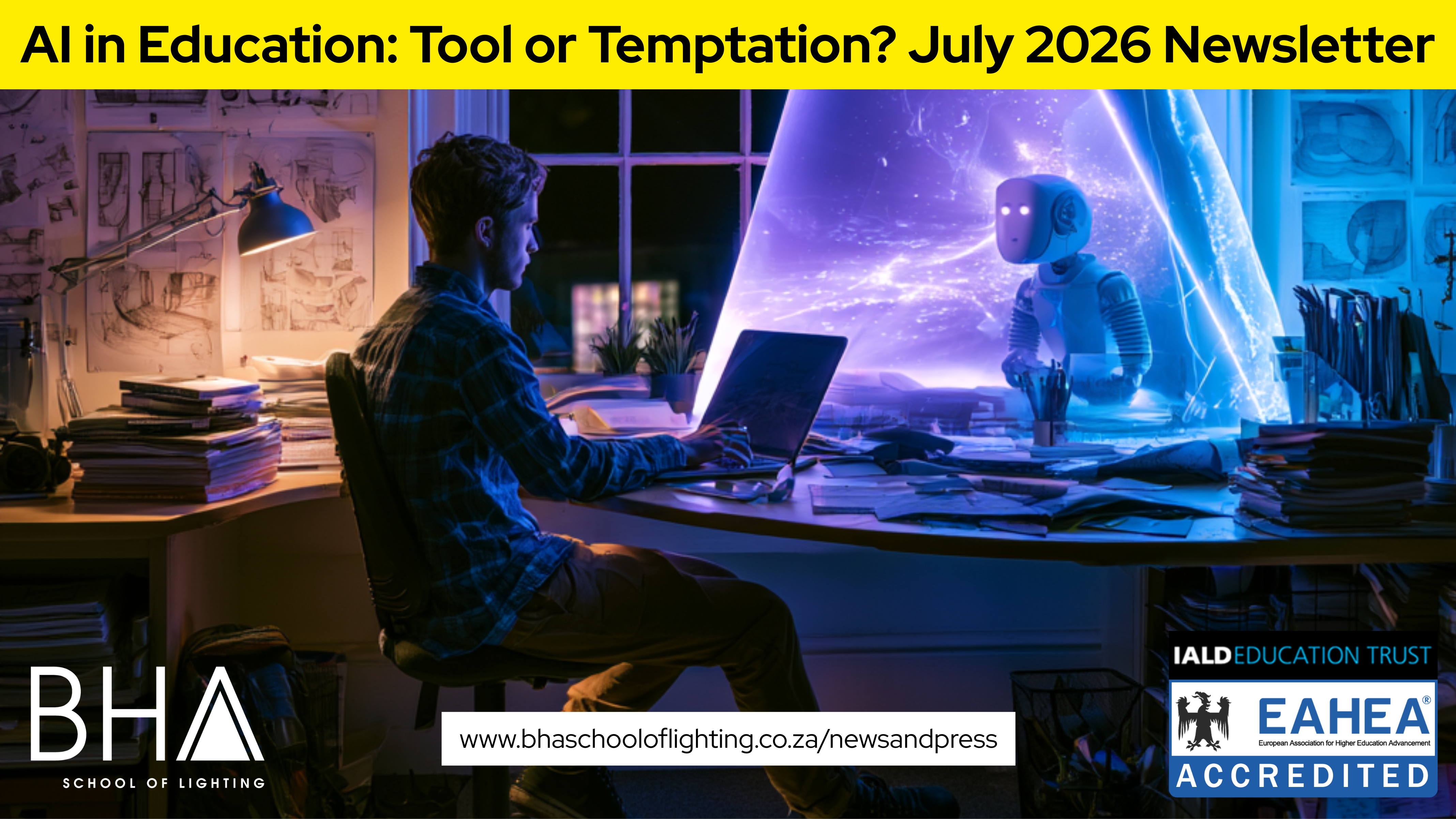
02 Jul AI in Education: Tool or Temptation? July 2026 Newsletter
Artificial Intelligence (AI) has rapidly become one of the most talked about developments in education. From generating research summaries and explaining complex concepts to assisting with writing and problem solving, AI offers students capabilities that would have seemed unimaginable only a few years ago.
But as these technologies become increasingly integrated into education, an important question emerges: Is AI a valuable learning tool, or has it become a temptation that undermines the learning process?
The answer, perhaps unsurprisingly, is both.
When generative AI tools first appeared, many educational institutions, including BHA School of Lighting, adopted a cautious approach. The concern was never the technology itself, but rather the possibility that students would use AI to replace learning rather than support it. At the same time, there was widespread recognition that AI would become a normal part of professional life and that students needed to understand how to use it effectively.
Today, AI can help students explore ideas, organise research, improve their writing, and gain a deeper understanding of complex topics. Used correctly, AI can enhance learning. Used incorrectly, it can become a shortcut that weakens the very skills education is intended to develop.
When the Tool Becomes the Temptation
Recent experience has shown that the use of AI by some students has reached concerning levels. In several cases, particularly within Second Year assignments of the Advanced Diploma in Illumination Engineering & Lighting Design, submitted work has contained content that does not align with the course material, prescribed manuals, or learning outcomes.
While the assignments may appear polished and well written, they often demonstrate limited evidence of critical thinking, personal insight, or meaningful engagement with the subject matter. This raises important questions about authenticity, understanding, and academic integrity.
The purpose of education is not simply to complete assignments. It is to develop knowledge, judgement, analytical thinking, and professional competence. When AI does the thinking for the student, the learning opportunity is diminished.
What Are Educational Institutions Doing?
Institutions around the world are grappling with the same challenge and, broadly speaking, three approaches have emerged.
Some institutions continue to follow a prohibition model, where AI use is largely banned and may be treated as academic misconduct. These institutions often rely on supervised assessments, handwritten submissions, oral examinations, or other methods designed to minimise AI use.
Others have adopted a restricted or conditional use model, allowing AI to be used only for specific purposes such as research, brainstorming, editing, or language support. Students are expected to operate within clearly defined limits and, in some cases, obtain permission from the lecturer.
A growing number of institutions have embraced open use with disclosure. Under this approach, students are permitted to use AI provided they clearly explain how it was used. They may be required to identify the AI platform used, describe the extent of AI assistance, explain how AI contributed to the assignment, and in some cases provide a record of the prompts used.
Despite these differing approaches, there is increasing agreement that transparency and accountability are essential.
A Growing Consensus
Across the higher education sector, there is growing convergence around several key principles.
Students should declare any use of AI in assessed work. Assignments should include an AI usage statement where appropriate. Students should be able to explain how AI contributed to the final submission, and most importantly, responsibility for the quality, accuracy, and integrity of the work must remain with the student.
In other words, AI can assist with learning, but it cannot assume responsibility for learning.
The Impact on Assessment
The rise of AI is changing not only how students learn, but also how educators assess learning.
Increasingly, institutions are redesigning assessments to focus less on the final answer and more on the thinking behind it. Greater emphasis is being placed on critical thinking, analysis, evaluation, personal reflection, problem solving, and the application of knowledge to real world situations.
Students may therefore be asked to submit drafts, notes, research records, design development documentation, reflections, or even participate in discussions and oral presentations that demonstrate their understanding of the subject matter.
The focus is shifting from “What answer did you produce?” to “How did you arrive at that answer?”
Recognising Over Reliance on AI
While AI detection tools are available, many educational institutions remain cautious about relying solely on them. Instead, educators often look for indicators that may suggest excessive dependence on AI.
These indicators can include writing that is overly generic, a lack of personal insight, limited engagement with course materials, inconsistencies with a student’s established writing style, and content that does not align with prescribed manuals, lectures, or learning resources.
In some cases, assignments may even contain inaccurate information, fabricated references, or examples that are irrelevant to the topic being assessed.
None of these indicators prove AI use on their own, but they can suggest that the technology has been relied upon excessively rather than used as a support tool.
Looking Ahead: AI Literacy, Not AI Avoidance
One of the clearest trends emerging globally is a movement away from asking whether students should use AI and towards teaching them how to use it responsibly.
Increasingly, educational institutions view AI as a new form of literacy. Just as students must learn to research, write, analyse, and communicate effectively, they must also learn how to work with AI intelligently and ethically.
This includes understanding when AI is appropriate to use, when it is not, how to evaluate AI generated information critically, how to maintain originality and academic integrity, how to protect privacy and data, and how to disclose AI use transparently and responsibly.
The future belongs not to those who simply use AI, but to those who understand its strengths, limitations, and risks.
The BHA School of Lighting Approach
At BHA School of Lighting, we recognise that AI will continue to influence both education and professional practice within the lighting industry.
For this reason, we are developing a new approach to learning that incorporates AI literacy throughout the curriculum. Rather than treating AI as a standalone topic, it will become a golden thread running through the educational experience, helping students understand both the opportunities and responsibilities associated with these powerful technologies.
Our goal is not to discourage the use of AI, nor to encourage dependence upon it. Instead, we aim to help students develop the judgement required to use AI as a professional tool while continuing to think independently, solve problems creatively, and build genuine expertise.
Because at the end of the day, AI may be able to generate answers, but only people can provide wisdom, judgement, and meaningful professional insight.
AI is undoubtedly a remarkable tool. Whether it remains a tool or becomes a temptation ultimately depends on how we choose to use it.
With best regards,
Philip Hammond
BHA School of Lighting
Sources consulted:UNESCO, Guidance for Generative AI in Education and Research (2023); Jisc guidance on AI and assessment (2024–2025); TEQSA Gen AI Knowledge Hub and assessment reform resources (2024–2026).
Must Watch: LIGHTING FOR TOMORROW with David Gilbey
“The present was once yesterday’s unimaginable future. It sounds obvious, but when we consider our current understanding of lighting and the technologies now at our disposal, the future becomes far more predictable,” says David.
Drawing on this perspective, David explores how modern lighting technologies can be used to honour our heritage and culture, positioning light as a powerful medium for communication and storytelling. He also highlights the value of interactive, experiential and immersive lighting experiences, as well as the critical role light plays in shaping and protecting our environment.
By encouraging holistic and thought provoking discussions about the future of lighting and its impact on society, this presentation promises to inspire viewers with fresh ideas and valuable insights that will help inform and influence their own lighting design decisions for years to come.
🎥 For more educational lighting content subscribe to our YouTube channel here.
BHA SCHOOL OF LIGHTING STUDENT NEWS
Celebrating Academic Excellence at BHA School of Lighting
We congratulate Mzukisi Keli, who has successfully passed the first year examinations of the Advanced Diploma in Illumination Engineering & Lighting Design course, we wish you all the best success as you begin your learning joourney in the second year of the course.
We wish the following BHA SoL students well, as they prepare for their First Year exams of the Advanced Diploma in Illumination Engineering & Lighting Design course:
Akshay Kumar, Dubai, United Arab Emirates
Toby Que, Manilla, Philippines
Burgher Nortje, Johannesburg, South Africa
Welcome to all new BHA SoL students, we hope you enjoy your learning experience of your chosen course:
David Joshua Nathaniel, Durban, South Africa – Advanced Diploma in Illumination Engineering & Lighting Design Course
Zandre Pienaar, Cape Town, South Africa – Foundation Lighting Course
Tshepo Derrick Rapetsoa, Johannesburg, South Africa –Advanced Diploma in Illumination Engineering & Lighting Design Course
Jeronimo Chetty, Boksburg, South Africa – Advanced Diploma in Illumination Engineering & Lighting Design Course
David Carr, East London, South Africa – Relux Desktop Software Course
David Kuli, Mumbai, India – Advanced Diploma in Illumination Engineering & Lighting Design Course
Tichaona Dauti, Harare, Zimbabwe – Advanced Diploma in Illumination Engineering & Lighting Design Course
BHA SoL Student Birthdays
Happy Birthday to the following past & present students who celebrate their birthdays this July! We hope you all have fabulous birthdays and that this next year of life brings great success and prosperity, and above all good health!
Lina Adel, Cairo, Egypt – 1 July
Renske Snyman, Cape Town, South Africa (Graduate) – 1 July
Fiona Reid, Randburg, Johannesburg, South Africa – 3 July
Jaroslaw Otremba, Warsaw, Poland (Graduate) – 3 July
Liam Abrahams, Cape Town, South Africa (Graduate) – 3 July
Samantha Hanmer-Woods, Canberra, Australia – 22 July
Sheetal Jain, Gurugram, Haryana, India – 23 July
Lynette Jeppe, Bloemfontein, South Africa – 24 July
Avinash Reddy Gopu, Dubai, United Arab Emirates – 27 July
Raymond Mokgoetsi, Johannesburg, South Africa – 31 July
FOLLOW US ON SOCIAL MEDIA
Join the BHA School of Lighting Alumni and follow us on LinkedIn here
Follow BHA School of Lighting on Instagram here
Subscribe to our YouTube channel here
JOIN A PROFESSIONAL LIGHTING COMMUNITY

We encourage all of our Advanced Diploma in Illumination Engineering students to apply for student membership for little or no fees at local and international professional lighting institutions and lighting network communities. By becoming a member you will gain access to further study material, courses, workshops, webinars & stipends.
BHA School of Lighting is proud to be affiliated with the the International Association of Lighting Designers, the Institute of Lighting Professionals, the Virtual Lighting Design Community, The Lighting Police, Women in Lighting and the Illumination Engineering Society of South Africa.
Find more info about each organisation and community here.
Our mailing address is:
BHA School of Lighting
48 Chestnut Ridge Circle, Chestnut Ridge
Royal Ascot, Cape Town
Western Cape, South Africa, 7441